
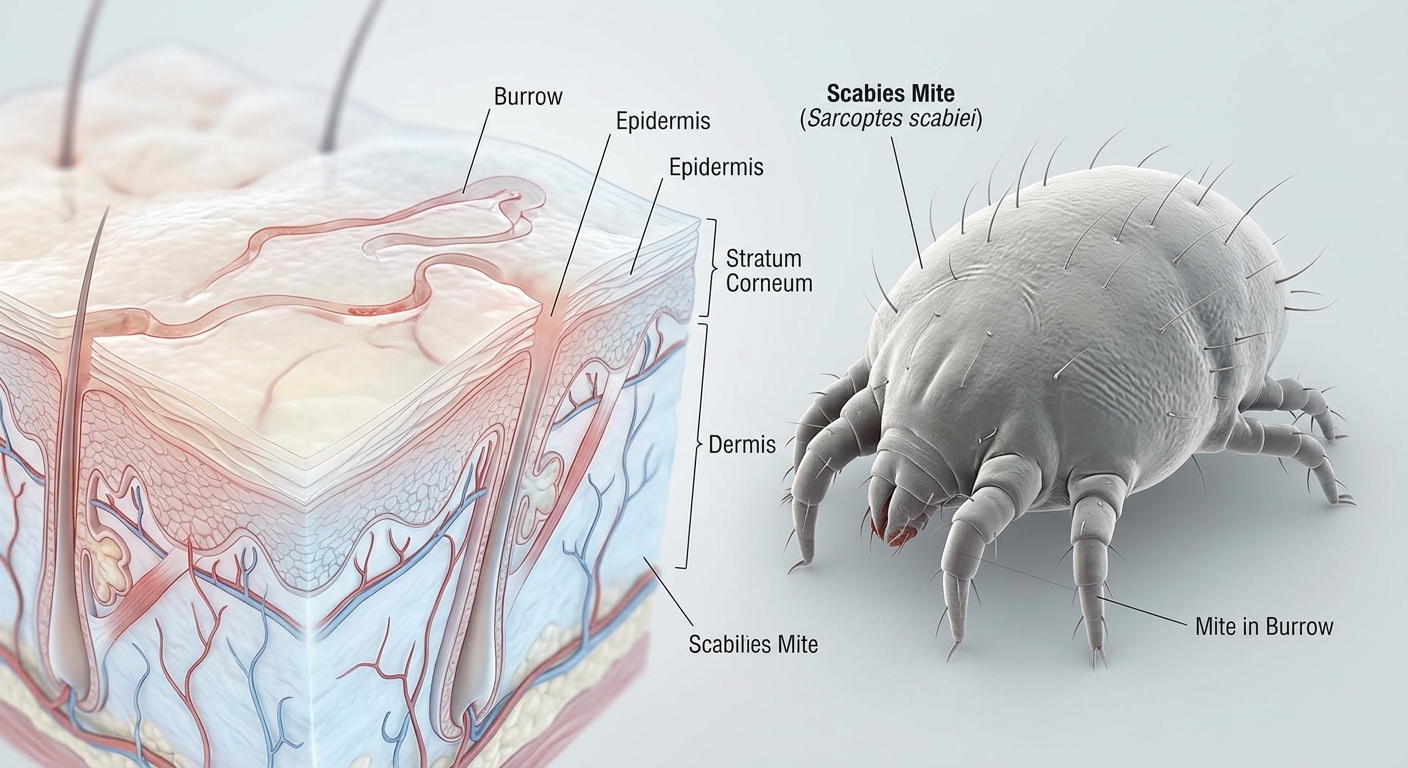
Scabies is a highly contagious ectoparasitic infestation caused by the microscopic mite Sarcoptes scabiei var. hominis. Successful clinical eradication depends on precise diagnosis, immediate treatment of close household contacts, targeted environmental decontamination, and managing persistent post-scabietic inflammatory pruritus.
Core Pathophysiology & Transmission Dynamics
- Pathogen & Mechanism: Female mites burrow into the stratum corneum, laying eggs and depositing feces (scybala). Symptoms stem from a Type IV delayed hypersensitivity reaction to mite proteins and waste.
- Transmission Pathways: Primarily transmitted via direct, prolonged skin-to-skin contact (>10–20 minutes). Fomite transmission via unwashed clothing or bedding is less common but significant in heavy infestations.
- Incubation Period: Initial infestation remains asymptomatic for 2 to 6 weeks while sensitization develops. Subsequent re-infestations trigger rapid hypersensitivity symptoms within 1 to 4 days.
- Anatomic Predilection: Mites seek warm, intertriginous areas: web spaces of fingers, flexor surfaces of wrists, axillary folds, belt line, areolae, umbilicus, scrotum, penis, and under breasts.
1. Age-Dependent Clinical Presentations
| Patient Population | Typical Lesion Distribution | Morphology & Key Features |
|---|---|---|
| Infants & Young Children (<2 years old) |
Palms, soles, scalp, face, neck, and flexor surfaces. Head and neck involvement is common. | Widespread vesicopustules, bullae, and prominent inflammatory nodular lesions on palms and soles. Intertriginous sparing is rare. |
| Older Children & Adults | Interdigital web spaces, anterior wrists, axillae, waistline, gluteal folds, and genitalia. Head and neck characteristically spared. | Classic linear S-shaped burrows, erythematous papules, excoriations, and secondary impetiginization from scratching. |
| Older Adults & Bedbound | Back, posterior trunk, pressure points, and intertriginous folds. | Excoriated papules frequently localized to the back; often misdiagnosed as senile pruritus or xerosis. |
| Crusted (Norwegian) Scabies (Immunocompromised Hosts) |
Generalized involvement; hands, feet, scalp, subungual hyperkeratosis. | Psoriasiform, hyperkeratotic crusted plaques containing thousands to millions of live mites; often lacks classic intense pruritus. Highly contagious via casual contact. |
2. Therapeutic Interventions & Decontamination Protocols
| Intervention Class | Medications / Action | Instructions & Clinical Notes |
|---|---|---|
| First-Line Topical Therapy | Permethrin 5% Lotion/Cream (Elimite®) | First-line treatment. Apply from neck down to toes (include scalp/face in infants/elderly). Leave on for 8 to 14 hours before washing off. Repeat application in 7 days to kill newly hatched larvae. Safe in pregnancy and infants ≥2 months. |
| First-Line Systemic Alternative | Oral Ivermectin (Stromectol®) | 200 mcg/kg PO single dose, repeated in 7–14 days. Ideal for institutional outbreaks, crusted scabies, or topical treatment failures. Relative contraindication: Children <15 kg or pregnant patients. |
| Contraindicated / Discontinued | Lindane 1% (Kwell®) Lotion/Shampoo | Not recommended. Carries high risk of neurotoxicity, encephalopathy, and seizures. Strictly contraindicated in pregnancy, young children, elderly, and patients weighing <50 kg. |
| Environmental Control | Hot water washing & high-heat drying OR Bagging | Wash bedding, linens, and clothing worn within the last 4 days in hot water (>50°C / 122°F) and dry on high heat. Non-washable items must be sealed in plastic bags for at least 1 week (mites die in 3–4 days without human host). |
Post-Scabietic Pruritus & Contact Management
A primary cause of treatment dissatisfaction is misunderstanding post-scabietic itching.
- Post-Scabietic Itching Pathophysiology: Intense pruritus can persist for 2 to 4 weeks post-treatment. This is not treatment failure, but a lingering hypersensitivity reaction to dead mites, ova, and feces trapped in the stratum corneum until skin sloughs.
- Managing Persistent Itch: Utilize bedtime oral sedating antihistamines (e.g., Hydroxyzine) for nocturnal symptom control and short courses of low-to-medium potency topical corticosteroids for localized inflammation.
- Treat All Contacts Simultaneously: All household members and close physical contacts must be treated concurrently, even if entirely asymptomatic, to prevent re-infestation loops.
3. Diagnostic Confirmation & Differential Workup
Diagnostic Workup & Differential Considerations
- Microscopic Confirmation: Apply mineral oil to a non-excoriated burrow or papule, shave or scrape with a #15 blade, and examine under low-power microscopy. Definitive confirmation requires visual identification of mites, larvae, ova, or scybala (fecal pellets).
- Dermoscopy (Onychoscopy/Dermatoscopy): Reveals the pathognomonic “delta-wing jet” or “triangular kite” sign representing the pigmented anterior portion of the female mite at the end of a burrow.
- Differential Rule-Outs: Distinguish from dyshidrotic eczema, papular urticaria, dermatitis herpetiformis, lichen planus, bullous pemphigoid, and bedbug bites (cimicosis).
High-Yield Exam & Practice Pearls
- Head & Neck Sparing Exception: Classic scabies spares the head and neck in older children and adults. However, infants, young children, elderly, and immunocompromised patients require head and scalp coverage during topical application.
- Lindane Black Box Warning: Never choose Lindane on board exams—it causes neurotoxicity and seizures, especially with broken skin, low body weight, or after hot baths.
- The “Re-Treatment” Trap: Do not mistake persistent itching at 2 weeks for active infection and re-treat immediately with topical toxins. Confirm active infestation via fresh scrapings or new burrows before repeating therapy beyond the standard 7-day booster dose.
- Crusted Scabies Management: Requires combination therapy: repeated doses of oral Ivermectin (Days 1, 2, 8, 9, 15) plus daily 5% Permethrin cream for 1–2 weeks along with keratolytic agents to break down crusts.