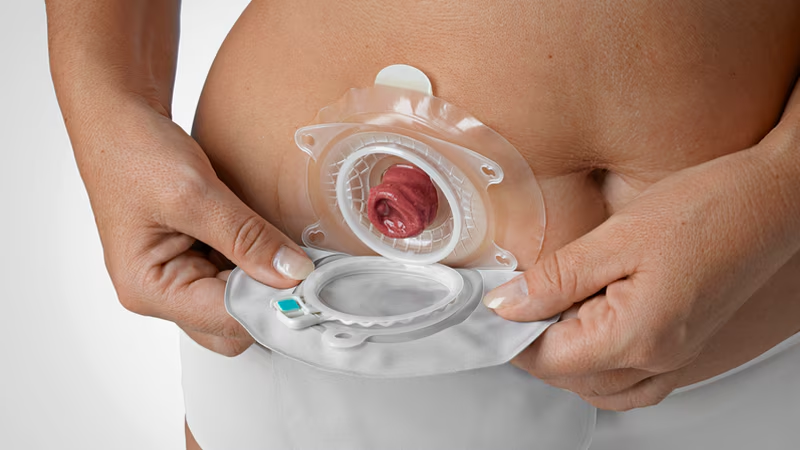

Recovering from urostomy surgery is a major life transition, but with the right education, support, and follow-up, most people adjust well and regain independence. The first eight weeks are especially important—this is when your stoma is healing, your body is adapting, and you are learning new self-care skills.
This guide walks you through what to expect from Week 0 through Week 8, including hydration, stoma care, complication prevention, mental health, and now a comprehensive section on peristomal skin complications, the most common issue after urostomy surgery.
Structured teaching helps you learn:
Research shows that early, structured ostomy education improves independence and quality of life (Davis et al., 2022; Tal et al., 2012; Irani et al., 2023).
A wound, ostomy, and continence nurse (WOCN) is essential in this phase, as ongoing nurse involvement lowers complication rates and boosts self-care success (Persson et al., 2025; Davis et al., 2022).
Because urine drains continuously, dehydration is one of the most common reasons for early readmission after urostomy surgery.
Your team will monitor:
Hydration (oral or IV) is initiated early (Davis et al., 2022; Irani et al., 2023; Ashley et al., 2021).
Enhanced Recovery After Surgery (ERAS) protocols emphasize:
This reduces the risk of postoperative ileus (Maffezzini et al., 2008).
This phase is about building confidence, refining your routine, and catching complications early.
Follow-up may occur:
This helps you fine-tune pouching techniques, reduce leakage, and prevent skin injury (Persson et al., 2025; Davis et al., 2022).
You will learn how to:
Patients need continued education on these skills throughout the early postoperative period (Tal et al., 2012; Khosla et al., 2025).
Your stoma will shrink in the first eight weeks, so pouch fitting must be checked regularly. Proper fit is essential to prevent leakage and protect the skin.
Strong self-care skills predict long-term success and quality of life (Tal et al., 2012; Zhang et al., 2025).
Your surgeon or urologist will routinely check:
These follow-up visits are essential for long-term kidney health (Khosla et al., 2025; Reddy & Kader, 2018).
Your care team will watch closely for:
Risk factors such as surgery type, sex, and ASA class influence resource needs and complication rates (Davis et al., 2022; Persson et al., 2025; Kang et al., 2025; Ashley et al., 2021; Khosla et al., 2025).
Care should be tailored to your unique needs.
Peristomal skin issues are the most common complication after urostomy surgery, occurring in 20–80% of patients depending on how they are measured (Davis et al., 2022; Sætre et al., 2023).
These include:
They can significantly affect comfort, confidence, and healthcare use (Tal et al., 2012; Sætre et al., 2023).
Risk increases with:
(ASCRS 2022; Hedrick et al., 2023; Persson et al., 2025)
The strongest protective step is preoperative stoma site marking by a WOCN.
This lowers leakage and skin complications and improves outcomes (Davis et al., 2022; Hedrick et al., 2023; Ashley et al., 2021).
Good surgical technique also matters:
Flush stomas greatly increase the risk of leakage and dermatitis (Hedrick et al., 2023).
During the first eight weeks, the stoma shrinks, so the opening of the appliance should be:
Skin should be completely dry before applying the appliance.
Helpful techniques include:
The ATTRACT randomized controlled trial showed that advanced skin-protection baseplates significantly reduce peristomal skin complications (Sætre et al., 2023).
A semiocclusive protocol using sodium carboxymethylcellulose fibers plus a thin hydrocolloid dressing has been shown to heal irritation within 4 weeks (Collado-Boira et al., 2021).
Requires team management with dermatology, GI, and wound care specialists (Morss-Walton et al., 2021).
Try:
Regular, personalized follow-up with a WOCN reduces complications and hospital resource use (Persson et al., 2025).
Education should cover:
Psychological support remains essential for long-term quality of life and adaptation (Zhang et al., 2025; Kang et al., 2025).
During the first eight weeks, you should contact your surgeon, WOCN, or emergency services immediately if you notice any of the following:
These may indicate a urinary tract infection or kidney infection, which can become severe quickly (1–2).
Also report:
These are signs of dehydration, the #1 cause of early readmission.
Pain, redness, open sores, or pus may indicate:
This may mean compromised blood supply and requires urgent evaluation.
Report:
These signs may indicate obstruction or mechanical complications.
This may indicate a parastomal hernia or bowel obstruction.
Especially if painful or associated with swelling or fever—could mean extravasation, fistula, or appliance failure.
This could indicate trauma, infection, or cancer recurrence.
The most effective early urostomy care includes: