
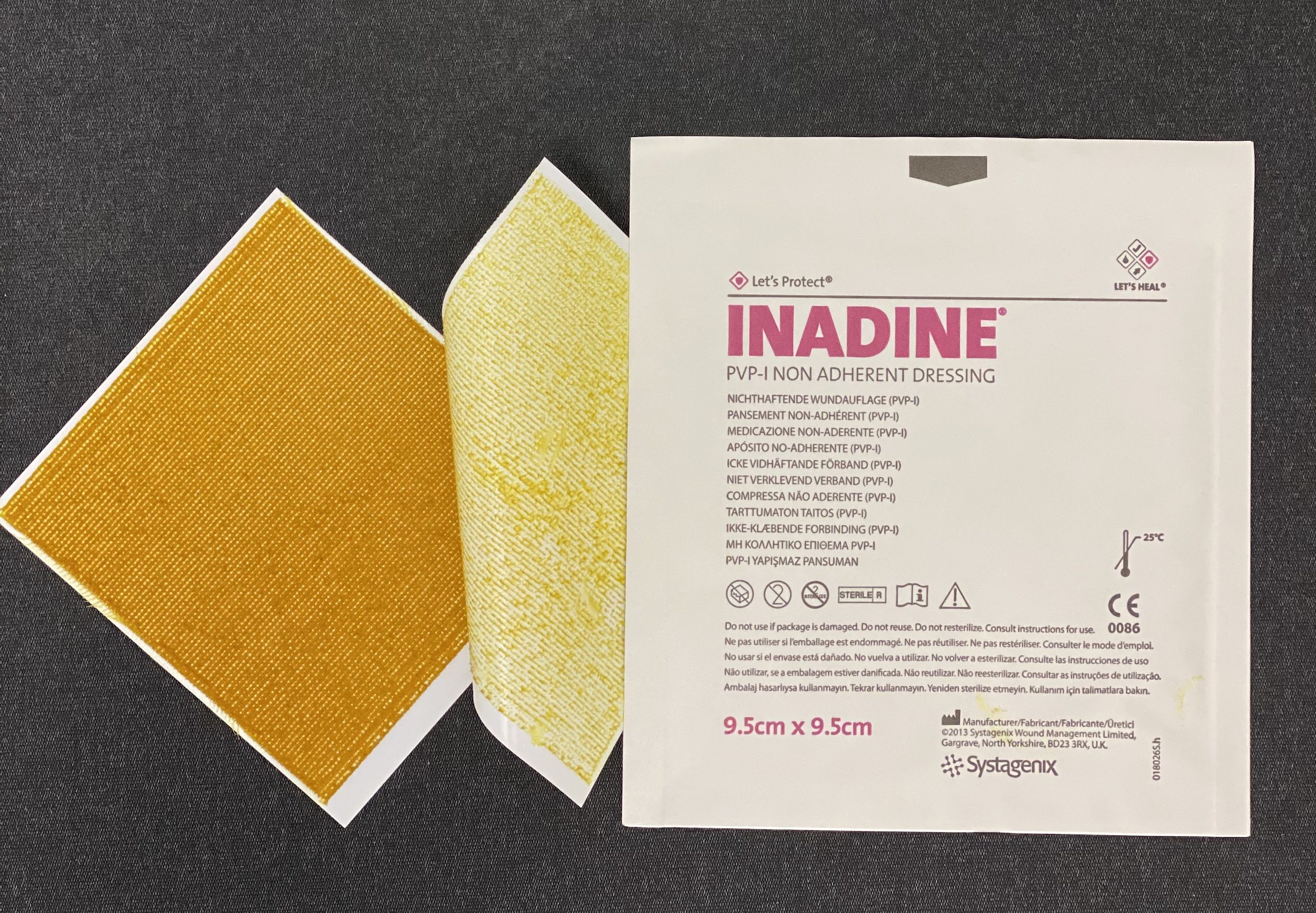
Managing local wound infection and maintaining a healthy wound bed requires effective, non-adherent antimicrobial solutions. Inadine is a widely trusted topical dressing designed to provide sustained antiseptic action while protecting fragile regenerating tissue. This operational guide breaks down its composition, indications, safety profiles, and step-by-step application protocols.
Key Points at a Glance
- Composition: Non-adherent viscose sheet impregnated with a polyethylene glycol base containing 10% povidone-iodine (equivalent to 1% available iodine).
- Primary Function: Delivers localized antiseptic action while minimizing adherence of secondary dressings to protect the underlying wound bed.
- Requirement: Functions as a primary dressing and always requires an appropriate secondary (cover) dressing.
- Available Sizes: 5 × 5 cm and 9.5 × 9.5 cm sheets.
Clinical Indications
Inadine is suitable for both adult and pediatric populations across a variety of clinical scenarios:
- Shallow Wounds: Ideal for superficial lesions with less than 1 cm depth.
- Maintenance & Non-Healing Wounds: Helps manage bioburden in chronic, stagnant wounds.
- Localized Infection: Effective in treating wounds exhibiting localized signs and symptoms of infection.
- Systemic Infection (Co-Therapy): Used in combination with systemic antibiotics when treating spreading or systemic infections.
- Prophylactic Care: Prevents bacterial colonization in patients identified as high-risk for wound infection.
Safety & Patient Assessment
Contraindications
Do NOT use Inadine in the following situations:
- Known hypersensitivity or allergy to iodine or any components of the dressing matrix.
- Deep wounds (greater than 1 cm depth), cavity wounds, undermining, or sinus tracts.
- Pregnant or breastfeeding individuals.
- Patients with Duhring’s dermatitis herpetiformis.
Precautions & Special Populations
- Neonates & Infants (< 6 months): Avoid use due to risk of systemic iodine absorption through immature or fragile skin.
- Lithium Therapy: Co-administration may increase the risk of hypothyroidism. Monitor thyroid-stimulating hormone (TSH) and blood work regularly.
- Renal Impairment: Compromised renal function increases the risk of elevated serum and urine iodine levels during prolonged treatment or large-surface application.
- Thyroid Disorders: Patients with pre-existing thyroid conditions are more sensitive to metabolic alterations during long-term therapy. Monitor thyroid function closely during extended or large-area use.
Step-by-Step Clinical Application Guide
| Phase | Clinical Step | Rationale & Clinical Pearl |
|---|---|---|
| 1. Selection |
Select an Inadine sheet slightly larger than the wound. If needed, cut or fold to match the exact size of the wound bed. Choose a suitable secondary dressing based on expected exudate levels. |
Cut the dressing before peeling off the backing paper for easier handling and precision. |
| 2. Preparation |
Cleanse the wound and surrounding skin using sterile normal saline or an approved cleanser. Thoroughly dry the periwound skin. Apply a skin barrier film to periwound skin if compatible with the chosen cover dressing. |
Protects periwound skin from Moisture-Associated Skin Damage (MASD) and Medical Adhesive-Related Skin Injury (MARSI). Note: Barrier films may reduce adhesion on certain silicone secondary dressings. |
| 3. Application |
Peel off one backing paper, lift dressing from the remaining paper, and lay a single layer directly onto the wound bed. Apply the selected secondary dressing. |
Critical Do not apply multiple layers. Stacking layers can block exudate transfer to the secondary dressing, leading to periwound maceration. Never apply with backing paper attached! |
| 4. Removal |
Gently lift the edges of the secondary dressing. Carefully peel the Inadine sheet away from the wound bed. |
To minimize MARSI risk, consider an adhesive remover for the secondary dressing. Gentle diagonal stretching of the Inadine dressing can ease removal. |
Change Frequency & Visual Indicator
Inadine features a built-in visual indicator to optimize dressing change timing:
- Color Change Indicator: As povidone-iodine is depleted, the dressing turns from orange to white. A white dressing signifies a loss of antiseptic efficacy and indicates that it is time for a change.
- Frequency: Can remain in place for up to 7 days depending on exudate levels, or changed up to twice daily if exudate levels are high and the iodine depletes rapidly.
Expected Clinical Outcomes
- Resolution of localized wound infection within 14 days.
- Effective prevention of infection when used prophylactically.
- Atraumatic dressing changes without adherence to the healing wound bed.
Clinical Escalation: If the product fails to perform as expected, escalate the case to a Wound Ostomy Continence Nurse (NSWOC) or Wound Clinician, and consider submitting a Supply Chain Product Concern Form within your organization.