
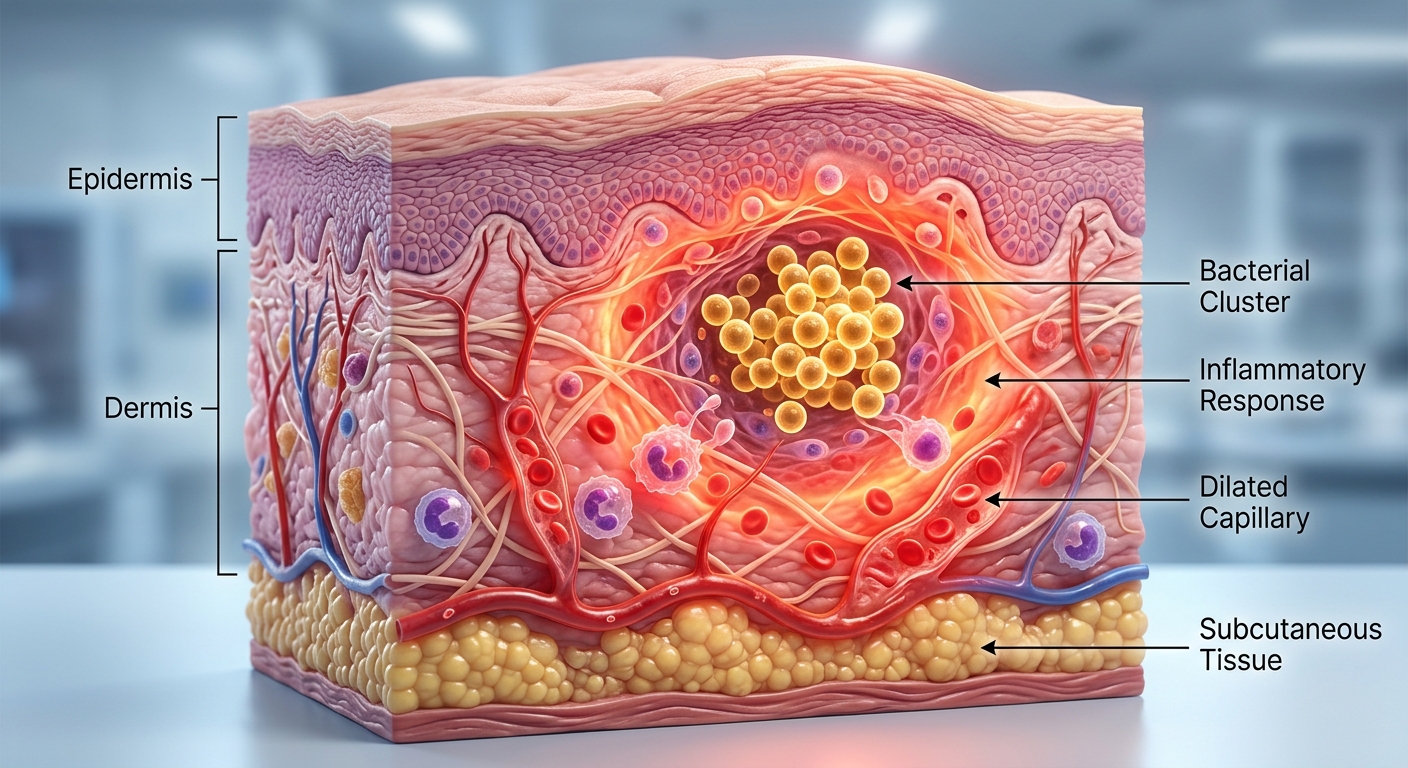
Cellulitis and cutaneous abscesses are prevalent bacterial skin and soft tissue infections (SSTIs) primarily driven by gram-positive cocci. Distinguishing non-purulent tissue involvement (cellulitis) from focal purulent fluid collections (abscess) is vital, as primary management hinges on targeted antimicrobial therapy versus source control through incision and drainage.
Core Microbiology & Pathophysiologic Distinctions
- Cellulitis (Non-Purulent): Acute spreading infection of the deep dermis and subcutaneous tissue. Originates from micro-trauma or skin barrier breaches (abrasions, tinea pedis, ulcers). Predominantly caused by Group A Beta-Hemolytic Streptococci (e.g., Streptococcus pyogenes) and Staphylococcus aureus (MSSA).
- Cutaneous Abscess (Purulent): Localized collection of pus within the dermis and subcutaneous space, characteristically caused by Staphylococcus aureus (~75% of cases), with a high prevalence of Community-Acquired MRSA (CA-MRSA).
- The “Spider Bite” Fallacy: CA-MRSA abscesses presenting with central necrosis or eschar formation are frequently misdiagnosed by patients as brown recluse spider bites (Loxosceles reclusa).
- Systemic Severity Warning: Severe or complicated disease can manifest with high fever, rigors, systemic inflammatory response syndrome (SIRS), rapidly progressive erythema, and pain disproportionate to exam findings (a red flag for necrotizing fasciitis).
1. Pathophysiology, Clinical Features & Differential Diagnosis
| Condition | Primary Microbiology | Clinical Presentation | Differential Diagnoses |
|---|---|---|---|
| Cellulitis (Non-Purulent SSTI) |
Group A Streptococci (most common) MSSA (Gram-negatives in immunocompromised) |
Spreading erythema, warmth, edema, and tenderness with poorly or sharply demarcated borders. Lymphangitic streaking (“red lines”) and regional lymphadenitis are common. Typically involves extremities. | Deep Vein Thrombosis (DVT), Stasis Dermatitis, Contact Dermatitis, Erythema Migrans (Lyme), Gout, Septic Bursitis, Osteomyelitis. |
| Cutaneous Abscess (Purulent SSTI) |
Staphylococcus aureus (~75%) (CA-MRSA & MSSA) |
Painful, erythematous, fluctuant nodule often surrounded by a secondary rim of cellulitis. May exhibit spontaneous purulent drainage or central necrosis. Systemic symptoms absent in simple cases. | Epidermoid Cyst (ruptured/infected), Folliculitis, Furuncle/Carbuncle, Hidradenitis Suppurativa, Myiasis, Nodular Lymphangitis. |
2. Diagnostic & Laboratory Workup Protocol
| Clinical Scenario | Indication Criteria | Recommended Diagnostic Evaluation |
|---|---|---|
| Uncomplicated Presentation | Localized, mild disease; no systemic signs; healthy host. | No testing indicated. Diagnosis is purely clinical. Empirical treatment initiated immediately. |
| Complicated Cellulitis | Systemic toxicity, severe pain, extensive spread, underlying comorbidities (DM, cirrhosis, renal failure). | CBC with differential, Blood Cultures (x2), Serum Creatinine, Bicarbonate, Inflammatory Markers (CRP/ESR), CPK (to assess muscle involvement/necrotizing disease). Lower extremity venous duplex ultrasound if DVT suspected. |
| Complicated / Recurrent Abscess | Severe infection, systemic symptoms, recurrence, treatment failure, extremes of age, immunosuppression. | Gram stain and Wound Culture/Susceptibility testing of purulent aspirate. Blood cultures if fevers or systemic signs present. |
3. Therapeutic Management & Antimicrobial Regimens
| Clinical Category | Primary Modality / Regimen | Clinical Practice Considerations |
|---|---|---|
| Non-Purulent Cellulitis (Low MRSA Risk) |
Oral: Cephalexin (500 mg QID), Dicloxacillin, or Azithromycin / Clindamycin (if Penicillin-allergic). | Targets Streptococci and MSSA. Adjunctive care: elevation of affected limb to promote venous/lymphatic drainage, warm compresses. Expect improvement within 48–72 hours. |
| Cellulitis with MRSA Risk (Surrounding Furunculosis or High Local Prevalence) |
Dual/Covered Oral: TMP-SMX (Bactrim®) PLUS Cephalexin OR Doxycycline / Clindamycin alone. |
TMP-SMX provides excellent MRSA coverage but unreliable Streptococcal coverage; adding Cephalexin ensures dual protection against both pathogens. |
| Recurrent Lower Extremity Cellulitis | Chronic suppressive oral antibiotics (weeks/months) + aggressive interdigital care. | Inspect and treat interdigital toe spaces for tinea pedis (maceration/scaling), which serves as a bacterial portal of entry. Manage underlying edema, diabetes, or venous stasis. |
| Simple Cutaneous Abscess (<5 cm, Afebrile) |
Incision & Drainage (I&D) alone + warm soaks. | Source control is primary. Antimicrobial therapy is unnecessary for small, localized abscesses without surrounding cellulitis or systemic signs. Culture recommended. |
| Complicated / Large Abscess (≥5 cm, Systemic Signs, or Immunocompromised) |
I&D PLUS Oral Antibiotics: TMP-SMX, Doxycycline, or Clindamycin. Linezolid (Zyvox®) for refractory/severe oral outpatient therapy. |
Antibiotics must reliably cover CA-MRSA. Beta-lactams alone (e.g., Cephalexin) are ineffective against MRSA. Linezolid is effective but restricted by cost and toxicity risks. |
| Parenteral Inpatient Therapy (Severe / SIRS / Refractory SSTI) |
Standard IV: Vancomycin, Daptomycin, Linezolid. Long-Acting IV: Dalbavancin, Oritavancin, Ceftaroline. |
Indicated for hemodynamic instability, mental status changes, severe immunosuppression, or rapid progression. Long-acting lipoglycopeptides (Dalbavancin/Oritavancin) permit early outpatient discharge. |
Critical Diagnostic Red Flags: Necrotizing Fasciitis
A life-threatening surgical emergency that rapidly progresses along deep fascial planes.
- Key Diagnostic Red Flag: Severe pain disproportionate to physical exam findings.
- Cutaneous Clues: Bullae (especially hemorrhagic), skin necrosis, violaceous discoloration, sensory anesthesia, and subcutaneous crepitus (gas-producing anaerobes/mixed infection).
- Action: Urgent, non-delayed surgical debridement and broad-spectrum parenteral coverage (e.g., Vancomycin + Piperacillin-Tazobactam + Clindamycin for antitoxin effect).
High-Yield Exam & Practice Pearls
- Bactrim Mono-Therapy Warning: Do not rely on TMP-SMX (Bactrim) as monotherapy for non-purulent cellulitis because its activity against Group A Streptococcus is unpredictable; always combine with a beta-lactam (e.g., Cephalexin) or choose Clindamycin/Doxycycline.
- Abscess Primary Therapy: Incision and drainage is the cornerstone of cutaneous abscess treatment. Antibiotics without drainage will fail to cure an abscess.
- CA-MRSA “Spider Bite” Pitfall: Suspect CA-MRSA in any patient presenting with a self-reported “spider bite” featuring a necrotic center or central purulence.
- Lower Extremity Cellulitis Risk Driver: Tinea pedis (athlete’s foot) between the toes is the most common underlying portal of entry for recurrent lower limb cellulitis.
- DVT Rule-Out: Unilateral lower extremity edema, erythema, and warmth can mimic or coexist with Deep Vein Thrombosis; perform a duplex ultrasound if clinical suspicion is elevated.