
Burn injuries affect approximately 500,000 individuals annually in the United States, with ~90% successfully managed in outpatient settings. Accurate initial resuscitation, precise depth and TBSA estimation, adherence to burn center referral guidelines, and topical infection control are critical for optimal functional and cosmetic recovery.
Primary Triage & Initial Assessment Workflow
- Primary Survey First: Prioritize Advanced Trauma Life Support (ATLS) principles—ensure airway stability, monitor for inhalation injury, assess breathing, and manage fluid resuscitation before focusing on local burn care.
- TBSA Estimation: Utilize the Rule of Nines (adults) or Lund-Browder Chart (pediatrics). The patient’s palmar surface (palm plus digits) represents ~1% TBSA across all age groups.
- Wound Sterility & Colonization: Burn surfaces are essentially sterile for the first 48 hours. Gram-positive organisms (S. aureus, Streptococci) colonize early, followed by Gram-negative pathogens (P. aeruginosa, E. coli) and enterococci.
- Infection Control: Routine systemic antibiotic prophylaxis is not recommended; topical antimicrobial agents and advanced specialized dressings are the standard of care.
1. Burn Depth Classification & Clinical Features
| Depth Grade | Anatomic Level | Clinical Appearance | Sensation & Healing |
|---|---|---|---|
| Superficial (1st Degree) | Epidermis only | Erythematous, dry, warm; blanches readily with pressure; no blisters. | Painful; heals in 3–6 days without scarring. |
| Superficial Partial-Thickness (2nd Degree) | Epidermis & superficial dermis (papillary layer) | Erythematous, wet/moist, intact or ruptured blisters; intact capillary refill. | Very painful (intact nerve endings); heals in 7–21 days with minimal scarring. |
| Deep Partial-Thickness (Deep 2nd Degree) | Epidermis & deep dermis (reticular layer) | Mottled pink-to-white, dry or waxy; sluggish or absent capillary refill (does not blanch). | Diminished pinprick sensation; requires >21 days; high risk of hypertrophic scarring/contracture. |
| Full-Thickness (3rd Degree) | Complete dermis & underlying subcutaneous tissue | Leathery eschar, charred, translucent, white, or mahogany; rigid; non-blanching. | Anesthetic (destroyed sensory nerves); requires surgical excision and grafting. |
2. Outpatient Wound Care & Dressing Options
| Dressing Category | Representative Options | Primary Clinical Indication |
|---|---|---|
| Topical Antimicrobial Agents | Silver Sulfadiazine (Silvadene®), Mafenide Acetate (Sulfamylon®) | Broad Gram(+)/(-) antibacterial control; silver sulfadiazine is contraindicated on the face or in sulfa allergies. |
| Low-Cost Protective Dressings | Petroleum gauze, petrolatum ointment | Simple tissue protection and moisture retention for minor superficial burns. |
| Non-Absorptive Dressings | Xeroform®, Mepitel®, Acticoat™ | Protects healing epithelium; silicone/silver-coated meshes minimize dressing change pain and tissue disruption. |
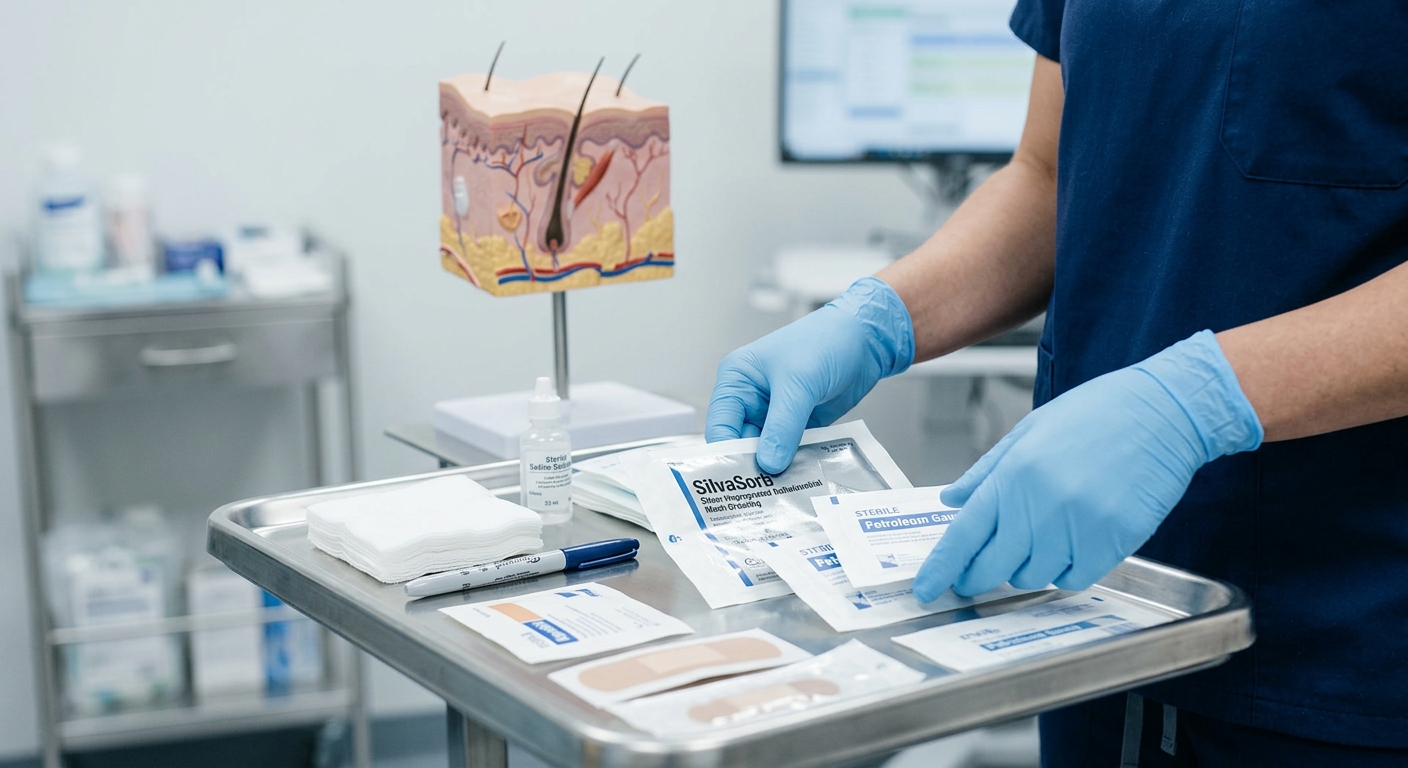
| Absorptive Dressings | Aquacel® Ag, DuoDERM® (Hydrocolloids) | Manages moderate-to-heavy exudate in partial-thickness burns while maintaining a moist healing environment. |
| Biocomposite / Biosynthetic | Biobrane® | Temporary skin substitute for clean, superficial partial-thickness burns; decreases pain and dressing frequency. |
🚨 American Burn Association (ABA) Burn Center Referral Criteria
Prompt consultation or transfer to a specialized burn center is recommended for patients meeting any of the following criteria:
- TBSA Thresholds: Partial-thickness burns >10% TBSA (>5% in pediatric populations).
- Full-Thickness: Third-degree burns in any age group.
- Anatomic High-Risk Areas: Burns involving the face, hands, feet, genitalia, perineum, major joints, or circumferential limb/chest burns.
- Mechanism: Electrical burns (including lightning injuries) and high-concentration chemical burns.
- Inhalation Injury: Known or suspected smoke inhalation requiring airway management.
- Special Populations: Pre-existing medical comorbidity, concomitant trauma, pediatric patients without specialized pediatric staff, or requiring specialized social/rehabilitative support.
3. Rehabilitation, Scar Management & Safeguarding
Long-Term Outpatient Optimization
- Follow-Up Schedule: Initial evaluation within 24 hours to re-assess pain and dressing integrity; weekly follow-ups thereafter until complete re-epithelialization occurs.
- Scar Mitigation: Initiate scar massage, custom compression garments (20–30 mmHg), topical silicone sheeting, or intralesional corticosteroid injections for hypertrophic scarring.
- Contracture Prevention: Early physical and occupational therapy referral for burns bridging major joints to preserve range of motion.
- Safeguarding & Non-Accidental Trauma: Evaluate for non-accidental burn patterns in pediatric and dependent adult patients (e.g., clear water lines, spared flexor creases, “glove-and-stocking” immersion scalding, cigarette burns). Mandatory reporting required when abuse is suspected.
High-Yield Exam & Practice Pearls
- Pain vs. Depth Trap: 2nd-degree burns are the most painful due to exposed nerve endings; 3rd-degree burns are painless in the center due to complete nerve destruction, though surrounded by painful 2nd-degree areas.
- Rule of Nines Warning: Do NOT include 1st-degree (superficial) burns when calculating Total Body Surface Area (% TBSA) for fluid resuscitation formulas (e.g., Parkland formula).
- Silver Sulfadiazine Contraindication: Avoid on the face (transient hyperpigmentation risk), near the eyes, in sulfa allergy, or in infants <2 months old.
- Inhalation Injury Clues: Singed nasal hairs, facial burns, carbonaceous sputum, or hoarseness warrant immediate intubation prior to airway edema development.