
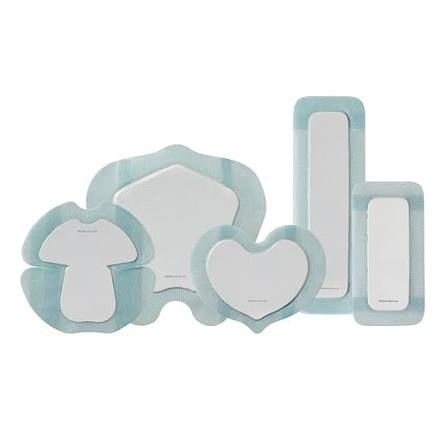
Biatain® Silicone Ag is an all-in-one antimicrobial silver foam dressing designed for exuding wounds exhibiting signs of local infection, suspected biofilm, or elevated risk of contamination. Combining a conformable polyurethane foam core, integrated soft silicone adhesive border, and broad-spectrum ionic silver, it provides effective exudate management and micro-organism control while supporting gentle, atraumatic dressing changes.
Key Technical Specifications & Overview
| Dressing Format | Absorbent polyurethane foam with integrated silicone adhesive border & top protective film |
| Core Technology | 3DFit® Technology (conforms vertically to wound depth up to ~2 cm to eliminate dead space) |
| Antimicrobial Agent | Patented ionic silver complex (sustained release for up to 7 days; active against biofilm) |
| Application System | 3-piece no-touch opening system for sterile, easy placement |
| Available Sizes | 7.5×7.5 cm, 10×10 cm, 12.5×12.5 cm, 15×15 cm, 17.5×17.5 cm, 10×20 cm, 10×30 cm |
Mechanism of Action & Product Features
Biatain Silicone Ag integrates physical fluid management with targeted antimicrobial delivery:
- 3DFit® Conformability: Expands vertically upon contact with exudate to conform to the wound bed up to 2 cm depth, preventing fluid pooling in dead spaces.
- Sustained Silver Ionic Delivery: Provides broad-spectrum antimicrobial protection continuously for up to 7 days.
- Efficacy Against Biofilm: In-vitro testing demonstrates the ability to kill mature bacterial biofilms and prevent new biofilm formation.
- Gentle Silicone Border: Provides reliable, self-adherent fixation while protecting fragile periwound skin during removals.
- Water- and Bacteria-Proof Top Film: A semi-permeable film protects against external fluid and microbial contamination while supporting moisture balance.
Clinical Indications
Biatain Silicone Ag is indicated for exuding wounds where antimicrobial therapy and self-adherent fixation are required:
- Local Infection: Exuding wounds presenting with localized infection signs (pain, malodor, purulent drainage, erythema, stalled healing).
- Suspected Biofilm: Non-healing chronic wounds that stall or exhibit recurrent infection despite standard hygiene measures.
- Prophylactic Care: High-risk exuding wounds requiring infection prevention.
- Compression Therapy Co-Use: Safe to use beneath multi-layer compression systems for venous leg ulcer protocols.
Precautions & Contraindications
Contraindications
- Silver Allergy: Do not use in patients with known sensitivity or allergy to silver or dressing materials.
- Oxidizing Cleansers: Do not use alongside hydrogen peroxide or hypochlorite solutions.
- Critical Warning No Barrier Films: Do NOT apply barrier film sprays or wipes under the silicone border, as this interferes with adhesive function.
Precautions & Special Conditions
| Clinical Scenario | Practice Directive |
|---|---|
| Radiation & Imaging (X-Ray/CT/Ultrasound) | Remove prior to radiation therapy, X-rays, CT scans, ultrasonic treatment, or microwave therapy. |
| MRI Procedures | Safe to remain in place during MRI examinations. |
| Cleansing Agents | Use normal saline or sterile water only. Other cleansing solutions are unverified for safe compatibility. |
| Pregnancy, Lactation & Pediatrics | Safety has not been formally demonstrated; use only following specific clinical assessment. |
| Enzymatic Debriders & Electrodes | Do not combine with enzymatic debriding agents; avoid contact with conductive gels or electrical electrodes. |
Step-by-Step Application & Removal Protocol
| Phase | Clinical Step | Clinical Pearls |
|---|---|---|
| 1. Cleansing | Irrigate wound bed and periwound skin with sterile normal saline or sterile water. | Avoid unapproved wound cleansers or oxidizing agents. |
| 2. Preparation | Thoroughly dry periwound skin. Allow any applied creams/ointments to dry completely. | Do not use barrier films or wipes under silicone borders. |
| 3. Sizing | Select a size where the foam pad overlaps wound edges by at least 2 cm (~1 cm for very small wounds). | Ensure proper foam padding coverage; sizing affects both absorption and border adhesion. |
| 4. Application | Apply using the 3-piece no-touch system for aseptic handling. Lay pad over wound bed and smooth silicone border onto skin. | If exudate is low, lightly moisten foam pad with sterile saline prior to application. |
| 5. Removal | Gently lift border corners and gradually peel silicone edges away from skin. Flush with sterile saline if pad adheres to wound bed. | If foam sticks repeatedly, re-evaluate if an absorbent foam is still appropriate for the wound’s exudate level. |
Change Frequency & Expected Outcomes
- Change Interval: Change when clinically indicated or up to a maximum of 7 days.
- Exudate Indicator: Change immediately when visible exudate strike-through approaches the edge of the absorbent foam pad.
- Expected Outcome (Infection): Signs and symptoms of local wound infection should show improvement and achieve resolution within approximately 2 weeks.
- Expected Outcome (Prophylaxis): Prevention of localized bacterial infection in high-risk wounds.
Practice Pearls for Clinicians
- Preparation Matters: Completely dry skin is essential for optimal silicone adhesion. Skip barrier films entirely.
- Monitor Exudate Progress: Regularly inspect the foam pad through the top film; replace before exudate reaches the border margin.
- Re-assess Sticking Dressings: Adherence during removal indicates low exudate—consider transitioning away from absorbent foam.