
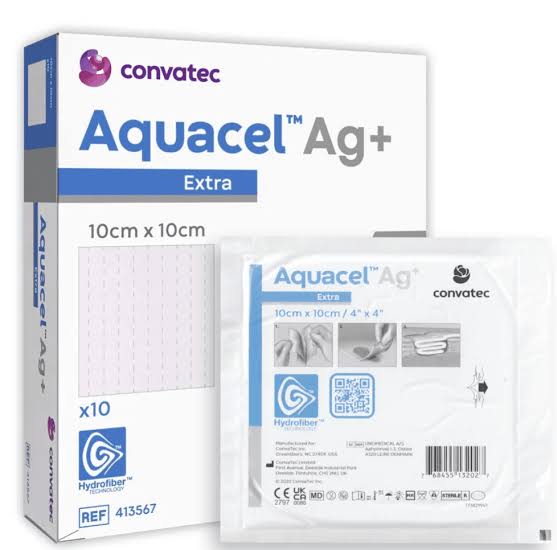
Aquacel® Ag+ Extra is a reinforced primary gelling fiber dressing engineered specifically for moderately to heavily exuding wounds facing local infection, persistent biofilm, or heightened infection risk. By combining sodium carboxymethylcellulose Hydrofiber® technology with a tri-active formulation of ionic silver, EDTA, and benzethonium chloride, this dressing simultaneously controls fluid, disrupts resilient biofilm structures, and delivers broad-spectrum pathogen eradication.
Key Technical Specifications & Overview
| Dressing Format | Reinforced 2-layer sodium carboxymethylcellulose stitched gelling fibers (Sheet & Ribbon) |
| Biofilm & Antimicrobial Tri-Active Complex | Ionic Silver: Broad-spectrum antimicrobial activity EDTA: Chelating agent that destabilizes biofilm matrix structures Benzethonium Chloride (BC): Surfactant that penetrates and breaks down biofilm |
| Primary Function | Heavy exudate absorption, micro-environment gelling, and active biofilm disruption |
| Requirement | Primary dressing; always requires an appropriate secondary cover dressing |
Mechanism of Action: Hydrofiber® & Biofilm Disruption
Aquacel Ag+ Extra pairs fluid-handling performance with targeted biochemical biofilm management:
- Cohesive Gelling Action: Upon contacting exudate, carboxymethylcellulose fibers transform into a clear, cohesive gel that locks in fluid, bacteria, and proteases without lateral moisture spreading.
- Biofilm Disruption (EDTA + BC): Ethylenediaminetetraacetic acid (EDTA) weakens the protective extracellular polymeric substance (EPS) matrix of biofilm, allowing the surfactant benzethonium chloride to break it down.
- Pathogen Eradication (Ionic Silver): Once the biofilm shield is compromised, silver ions directly penetrate and eliminate susceptible aerobic, anaerobic, and antibiotic-resistant bacteria as well as yeasts.
- Conformability & Strength: Stitch-bonded construction enhances wet strength, enabling easy, intact one-piece removal even when fully saturated.
Clinical Indications & Geometry Selection
Indicated for exuding superficial, deep, or complex cavity wounds requiring bioburden intervention:
- Infection & Biofilm Control: Indicated for wounds demonstrating clinical infection signs (pain, warmth, malodor, altered exudate) or recalcitrant wounds stalled by biofilm.
- Prophylactic Defense: Applied in high-risk patients to prevent surgical or chronic wound colonization.
- Flat & Superficial Wounds: Managed using Sheet Formats (5×5 cm, 10×10 cm, 15×15 cm, 20×30 cm).
- Cavities, Undermining & Sinus Tracts: Managed using Ribbon Formats (1×45 cm, 2×45 cm).
Safety, Precautions & Contraindications
Contraindications
- Component Hypersensitivity: Do not use in patients with known allergy to silver, sodium carboxymethylcellulose, EDTA, or benzethonium chloride.
- Oil-Based Topicals: Do NOT apply concurrently with petrolatum, paraffin, or oil-based ointments, as they coat the fibers and block gelling/silver release.
Precautions & Clinical Warnings
| Clinical Concern | Practice Directive |
|---|---|
| Cavity Over-Packing | Critical Never pack tightly. As fibers absorb fluid, they expand into a gel. Tight packing increases localized pressure, risking tissue injury or pressure necrosis. |
| Periwound Maceration | Ensure the secondary cover dressing is adequately absorbent to prevent fluid overflow onto periwound margins. |
| Radiation & MRI | Remove prior to therapeutic radiation exposure. Check institutional guidelines regarding MRI removal requirements. |
Step-by-Step Clinical Application & Removal Guide
| Phase | Clinical Step | Clinical Pearls |
|---|---|---|
| 1. Sheet Application (Flat Wounds) |
Cleanse wound bed with saline or sterile water and dry periwound skin. Apply dry sheet directly to wound bed, allowing a 1 cm overlap beyond wound edges. |
Hydrofiber® shrinks slightly as it gels. The 1 cm overlap accounts for contraction and protects wound margins. Overlap multiple sheets by 1 cm. |
| 2. Ribbon Application (Cavities/Tracts) |
Determine cavity dimensions. Lightly pack a single continuous ribbon piece into the wound space without forcing or compressing. Always leave a visible tail outside the wound. |
Do not cut ribbon lengthwise (reduces tensile strength). Document total packing piece count clearly in the clinical record. |
| 3. Secondary Cover Selection | Cover with an appropriate secondary dressing (e.g., moisture-balancing foam for moderate exudate or absorbent pad for heavy fluid). | For extreme exudate, non-silver standard Aquacel Extra may be layered on top of Aquacel Ag+ Extra if permitted by local protocol. |
| 4. Removal Protocol |
Remove secondary cover dressing. Locate ribbon tail or sheet edge and lift gently in one piece. Irrigate wound bed to cleanse remaining residual gel. |
If the dressing appears dry or adheres to the tissue, soak with sterile saline prior to removal. Adherence indicates the wound may produce insufficient exudate for a gelling fiber. |
Wear Time & Expected Outcomes
- Maximum Wear Time: Remains in place for up to 7 days, depending on exudate saturation, secondary dressing integrity, and clinical assessment.
- Infection Resolution: Localized infection signs (exudate, pain, malodor) should demonstrate notable improvement within 2 weeks.
- Evaluation Threshold: If no improvement occurs in 14 days, re-assess systemic infection risk, vascular perfusion, necessity for surgical debridement, and underlying host factors.