
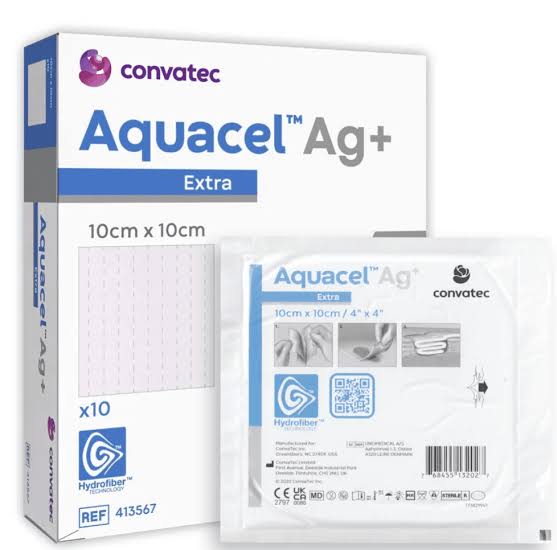
Aquacel Ag+ Extra Dressing: Clinical Uses, Application, Precautions, and Practice Guidelines
Published on
August 29, 2026
| Last Reviewed on
August 29, 2026

Aquacel® Ag+ Extra is a primary antimicrobial wound dressing designed for the management of moderately to heavily exuding wounds, particularly wounds with clinical infection, suspected biofilm, or an increased risk of infection.

The dressing combines highly absorbent sodium carboxymethylcellulose fibers with ionic silver, ethylenediaminetetraacetic acid (EDTA), and benzethonium chloride (BC). This combination provides exudate management while targeting microorganisms and biofilm within the wound environment.

What Is Aquacel Ag+ Extra?

Aquacel Ag+ Extra consists of two layers of sodium carboxymethylcellulose fibrous material reinforced by stitching to improve absorbency and wet strength.

The dressing incorporates three antimicrobial and antibiofilm components:

  • Ionic silver: Provides broad-spectrum antimicrobial activity against susceptible microorganisms, including aerobic and anaerobic bacteria, antimicrobial-resistant organisms, and yeast.
  • EDTA: Helps disrupt the structure of wound biofilm and increases the susceptibility of microorganisms within the biofilm to antimicrobial activity.
  • Benzethonium chloride (BC): A surfactant that works with EDTA to help disrupt biofilm and inhibit its reformation.

When Aquacel Ag+ Extra contacts wound exudate, the sodium carboxymethylcellulose fibers absorb fluid and transform into a soft, cohesive, conforming gel. This gel helps maintain a moist wound environment while retaining wound exudate within the dressing.

How Aquacel Ag+ Extra Works

Aquacel Ag+ Extra combines exudate management, antimicrobial activity, and biofilm disruption within a single primary dressing.

  • Absorbs moderate to heavy wound exudate.
  • Forms a soft gel as fluid is absorbed.
  • Conforms closely to the wound bed.
  • Helps maintain an appropriately moist wound-healing environment.
  • Provides ionic silver for antimicrobial activity.
  • Uses EDTA and benzethonium chloride to help disrupt biofilm and inhibit its reformation.
  • Helps reduce lateral spread of wound fluid when appropriately covered.

These characteristics make the dressing particularly useful when both microbial burden and exudate management are important components of the wound-care plan.

Clinical Indications for Aquacel Ag+ Extra

Exudate Level

Aquacel Ag+ Extra is primarily intended for wounds producing moderate to heavy amounts of exudate.

The dressing’s gelling fibers absorb wound fluid and retain it within the dressing while conforming to the wound surface.

Wound Infection and Biofilm

Aquacel Ag+ Extra may be considered when a wound demonstrates:

  • Clinical signs and symptoms of local wound infection
  • Suspected biofilm
  • Persistent or recurrent wound infection
  • Delayed or stalled wound healing associated with increased microbial burden
  • High risk for wound infection where prophylactic antimicrobial management is clinically appropriate

Clinical indicators of local wound infection may include increasing pain, increased or altered exudate, malodor, purulent drainage, friable granulation tissue, delayed healing, localized erythema, warmth, or swelling.

Suspected Biofilm

Biofilm should be considered in wounds that repeatedly fail to progress despite appropriate wound management, particularly when there is recurrent infection, excessive exudate, abnormal granulation tissue, or rapid deterioration following apparently successful treatment.

Aquacel Ag+ Extra is specifically designed to help disrupt biofilm and prevent its reformation while exposing microorganisms to the antimicrobial action of ionic silver.

Wound Geometry

Unlike flat contact dressings that are limited primarily to superficial wounds, Aquacel Ag+ Extra is available in formats that allow it to be used for:

  • Flat wounds
  • Wound cavities
  • Areas of undermining
  • Sinus tracts

The appropriate sheet or ribbon format should be selected according to wound dimensions and geometry.

Contraindications and Precautions

CategoryClinical Considerations
Hypersensitivity Do not use in patients with known sensitivity or allergy to silver, sodium carboxymethylcellulose, or other dressing components.
Oil-Based Products Avoid concurrent use with oil-based products such as petrolatum or paraffin, as these may interfere with dressing performance.
MRI Remove the dressing before MRI examination when required by current manufacturer or institutional guidance. Replace with an appropriate dressing following the procedure.
Radiation Therapy The dressing should not remain in place over an area receiving active radiation treatment. Remove before treatment when indicated and replace afterward according to the treatment plan.
Maceration Select an appropriate secondary dressing capable of managing the anticipated volume of exudate. Inadequate fluid management may contribute to periwound maceration and skin breakdown.
Wound Packing Do not tightly or excessively pack wound cavities. Over-packing may increase pressure within the wound and contribute to tissue injury or necrosis.

How to Apply Aquacel Ag+ Extra

1. Assess the Wound

Before selecting the dressing, perform a comprehensive wound assessment that includes:

  • Wound length, width, and depth
  • Presence and extent of undermining
  • Presence and depth of sinus tracts
  • Wound-bed tissue
  • Exudate amount and character
  • Periwound condition
  • Pain
  • Signs and symptoms of local infection
  • Signs of spreading or systemic infection
  • Factors suggesting persistent biofilm

The wound assessment should guide whether a sheet or ribbon formulation is most appropriate.

2. Select the Appropriate Dressing

Aquacel Ag+ Extra is available in sheet and ribbon formats for different wound shapes and depths.

FormatCommon SizesTypical Use
Sheet 5 × 5 cm
10 × 10 cm
15 × 15 cm
20 × 30 cm
Flat or relatively superficial wound beds
Ribbon 1 × 45 cm
2 × 45 cm
Cavities, undermining, and sinus tracts

3. Cleanse and Prepare the Wound

Cleanse or irrigate the wound using sterile normal saline or another approved wound cleanser according to organizational policy.

Gently dry the surrounding periwound skin while avoiding unnecessary trauma to the wound bed.

A suitable skin-barrier product may be applied to the periwound skin when clinically indicated. This can help protect the surrounding skin from excessive moisture and may improve adhesion of the secondary dressing or fixation tape.

Applying Aquacel Ag+ Extra Sheet

  1. Apply the Aquacel Ag+ Extra sheet dry directly to the wound bed.
  2. Position the dressing so that it extends approximately 1 cm beyond the wound margin onto the surrounding skin.
  3. The additional margin helps accommodate dressing contraction as wound exudate is absorbed.
  4. If more than one sheet is required, overlap adjacent dressing edges by approximately 1 cm.
  5. Apply an appropriate secondary dressing based on the wound’s anticipated exudate volume.

For wounds with particularly heavy exudate, standard Aquacel Extra may be layered over Aquacel Ag+ Extra when this approach is consistent with current manufacturer instructions and organizational wound-care protocols.

Using Aquacel Ag+ Extra Ribbon for Packing

The ribbon format may be used for wound cavities, undermining, and sinus tracts.

  1. Determine the dimensions and direction of the cavity, undermining, or sinus tract.
  2. Select an appropriately sized ribbon.
  3. Lightly place a single continuous piece of ribbon into the wound space.
  4. Do not tightly pack or compress the dressing into the cavity.
  5. Do not cut the ribbon lengthwise, as this may reduce its tensile strength.
  6. Leave a clearly visible tail outside the wound to facilitate safe removal.
  7. Document the number of packing pieces placed into the wound.
  8. Cover with an appropriate secondary dressing.

Why Should Wound Cavities Not Be Over-Packed?

Aquacel Ag+ Extra absorbs wound fluid and forms a gel within the wound space. Packing should therefore remain light and loose.

Excessive packing can create unnecessary pressure against wound tissues and may compromise local perfusion, potentially contributing to tissue injury or necrosis.

Selecting a Secondary Dressing

Aquacel Ag+ Extra generally requires an appropriate secondary cover dressing. Selection should be based primarily on the amount of wound exudate and condition of the surrounding skin.

  • Consider a moisture-balancing cover dressing for moderately exuding wounds.
  • Use a more absorbent secondary dressing when exudate volume is high.
  • Ensure the cover dressing is sufficiently large to contain wound fluid.
  • Protect vulnerable periwound skin when there is a risk of maceration.
  • Reassess the secondary dressing if leakage or periwound moisture damage develops.

Effective secondary dressing selection is essential because inadequate exudate management may result in maceration, leakage, and deterioration of the periwound skin.

Dressing Changes and Wear Time

Aquacel Ag+ Extra may remain in place for up to 7 days, depending on wound condition, infection status, exudate volume, and the performance of the secondary dressing.

Dressing-change frequency should be individualized according to:

  • Amount of wound exudate
  • Degree of dressing saturation
  • Presence of leakage
  • Condition of the periwound skin
  • Clinical infection status
  • Wound progression
  • Integrity and performance of the secondary dressing

The dressing should be reassessed and changed earlier when clinically indicated rather than automatically remaining in place for the maximum wear time.

How to Remove Aquacel Ag+ Extra

After absorbing wound fluid, Aquacel Ag+ Extra typically transforms into a soft, cohesive gel. The gel may take on the color of the absorbed wound exudate.

  1. Carefully remove the secondary dressing.
  2. Identify the edges of the Aquacel Ag+ Extra dressing.
  3. For packed wounds, locate the exposed ribbon tail before removal.
  4. Gently remove the dressing in one piece whenever possible.
  5. Forceps may be used when appropriate to facilitate controlled removal.
  6. Verify that all packing material has been removed from cavities, undermining, or sinus tracts.
  7. Irrigate or cleanse the wound bed as appropriate to remove residual gel or wound debris.
  8. Reassess the wound before applying the next dressing.

What If Aquacel Ag+ Extra Adheres to the Wound?

In a sufficiently exuding wound, Aquacel Ag+ Extra should absorb moisture and form a soft gel. If the dressing remains dry or adheres to the wound surface, the overall dressing system should be reassessed.

Possible considerations include:

  • The wound may be producing less exudate than anticipated.
  • The primary dressing may no longer be appropriate for the current wound condition.
  • The selected secondary dressing may be removing excessive moisture from the primary dressing.
  • The overall moisture balance of the wound may require adjustment.

A dressing that has become adherent should not be forcibly pulled from fragile wound tissue. Follow appropriate wound-care procedures to facilitate atraumatic removal and reassess dressing selection.

Expected Clinical Outcomes

Resolution of Local Wound Infection

Signs and symptoms of local wound infection should demonstrate clinical improvement, with an expected goal of resolution within approximately 2 weeks.

If infection does not improve as expected, reassess:

  • Wound etiology
  • Presence of persistent or recurrent biofilm
  • Need for debridement
  • Vascular status
  • Pressure, shear, or other mechanical factors
  • Systemic factors impairing wound healing
  • Possibility of deeper infection
  • Need for systemic antimicrobial therapy
  • Appropriateness of the current dressing regimen

Prevention of Wound Infection

When Aquacel Ag+ Extra is used prophylactically in an appropriately selected high-risk wound, the intended outcome is prevention of clinical wound infection.

Effective Exudate Management

The dressing should effectively absorb and retain wound exudate while maintaining an appropriate moisture balance and protecting the surrounding skin from maceration and moisture-associated damage.

Clinical Practice Pearls

  • Match Aquacel Ag+ Extra to the exudate level. The dressing is most appropriate for wounds producing moderate to heavy amounts of exudate.
  • Consider biofilm when healing repeatedly stalls. Persistent inflammation, recurrent infection, excessive exudate, and repeated failure to progress may indicate a biofilm-associated wound.
  • Use the correct format. Sheets are appropriate for flat wound surfaces, while ribbon can be used for cavities, undermining, and sinus tracts.
  • Allow approximately 1 cm of overlap. Aquacel may contract as it absorbs wound fluid and gels.
  • Never tightly pack a cavity. Ribbon should be placed loosely to avoid excessive pressure on wound tissues.
  • Always leave a retrieval tail. When ribbon is placed into a cavity, undermining, or sinus tract, a visible portion should remain outside the wound to facilitate safe removal.
  • Do not cut ribbon lengthwise. Doing so may compromise the structural integrity and tensile strength of the dressing.
  • Choose the secondary dressing carefully. Appropriate exudate management is essential for preventing leakage and periwound maceration.
  • Document wound packing. Record the number of pieces inserted and confirm that the same number is removed at the next dressing change.
  • Reassess antimicrobial therapy regularly. Antimicrobial dressings should not substitute for investigation and treatment of underlying factors when infection or delayed healing persists.

Aquacel Ag+ Extra at a Glance

Dressing Type Primary antimicrobial gelling fiber dressing
Primary Material Sodium carboxymethylcellulose
Antimicrobial Agent Ionic silver
Biofilm Technology EDTA + benzethonium chloride
Recommended Exudate Moderate to heavy
Wound Geometry Flat wounds, cavities, undermining, and sinus tracts
Available Formats Sheet and ribbon
Application Apply dry; allow approximately 1 cm overlap for sheets
Packing Lightly pack with a single piece of ribbon and leave a visible retrieval tail
Secondary Dressing Required; select according to exudate volume and wound condition
Maximum Wear Time Up to 7 days depending on clinical condition and exudate
Expected Infection Outcome Improvement and resolution of local infection signs within approximately 2 weeks

Key Takeaway

Aquacel Ag+ Extra is an antimicrobial gelling fiber dressing designed for moderately to heavily exuding wounds where infection, suspected biofilm, or increased infection risk is a clinical concern.

Its combination of sodium carboxymethylcellulose, ionic silver, EDTA, and benzethonium chloride allows the dressing to simultaneously manage wound fluid, provide antimicrobial activity, and help disrupt biofilm. Sheet and ribbon formulations also allow the dressing to accommodate both flat wounds and more complex wound geometries, including cavities, undermining, and sinus tracts.

Successful use depends on appropriate wound and exudate assessment, correct application, loose rather than tight packing, appropriate secondary dressing selection, protection of the periwound skin, and regular reassessment of the need for antimicrobial therapy.


Clinical Disclaimer: This article is intended for healthcare education and does not replace individualized clinical assessment, organizational wound-care protocols, or the manufacturer’s current instructions for use. Product indications, contraindications, application techniques, and recommendations should be verified against current manufacturer and institutional guidance before clinical use.

Connecting You and Primary Care
© 2026 TME HEALTHCARE. All rights reserved.